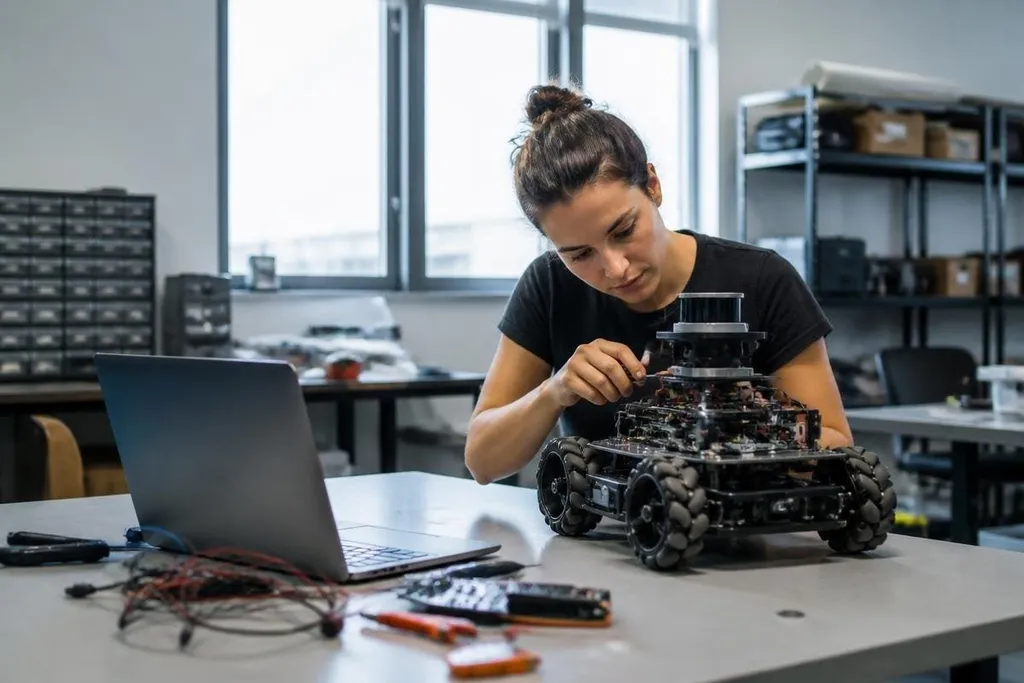
A roboticist may spend one day tuning a motor and the next tracing a software error through a sensor log. The work needs wide technical skills, careful testing, and the habit of explaining machines in plain words.
- Learn Python, C++, and basic Linux commands.
- Understand sensors, motors, control loops, and robot safety.
- Build small projects that show working results, not only course certificates.
Start with software and electronics
Python helps with data work, quick tests, and machine learning tools. C++ matters when code must run quickly on a robot with limited time for each control step. Linux ties much of this work together because many robot tools run there.
A future roboticist should also read a wiring diagram and use a multimeter. A motor that fails may have a software fault, a loose connector, a bad power supply, or a damaged driver. Checking those causes in order saves hours and keeps guesswork out of the repair.
ROS 2 is worth learning after these basics. It gives robot programs a common way to pass messages between parts such as cameras, controllers, and navigation nodes. A student who can start a ROS 2 package, inspect a topic, and record sensor data can work on a real robot without treating the software as a sealed box.
Learn how robots move
The math does not need to stay abstract. Kinematics describes where a robot’s joints place its hand or tool. Dynamics describes the forces behind that motion. A control loop compares the robot’s actual position with the target, then changes motor output to reduce the error.
Start with a proportional-integral-derivative, or PID, controller. It is a common way to adjust motor output from present error, past error, and the rate of change. Build one for a small wheeled robot or arm, then record how the robot behaves when the gain is too high or too low.
That habit matters because a robot can move in a lab and still fail during a longer run. Heat, battery voltage, cable drag, floor changes, and sensor noise all affect motion. Good work records the conditions, the change made, and the result.
Treat sensing as part of the job
A robot acts on measurements, not on the world itself. Cameras can lose detail in poor light. LiDAR can miss thin objects or reflect from glass. Wheel encoders can report motion while the wheels slip.
Learn how to inspect a sensor stream before changing the algorithm. Look for missing values, time stamps that drift, frames that do not match, and readings that jump without a physical reason. A small test with a known object often tells you more than a large software rewrite.
A future roboticist also needs to see how sensor choices hold up outside a lab. Robot24 covers robotics companies, machines, and research, giving you named systems to compare with the tests you run. That comparison helps turn a sensor check into evidence for the work ahead.
Build proof of your work
A portfolio project should show the problem, the hardware, the code, and the result. A short video helps, but the notes matter more: list the sensor used, the control method, the battery voltage, the failure cases, and the change that fixed each one.
Safety belongs in that record. Learn why an emergency stop exists, how a guarded work area differs from a collaborative robot setup, and how risk checks affect a design. ISO 10218 covers safety requirements for industrial robots, while ISO/TS 15066 addresses collaborative robot operation.
Communication decides how useful your technical work becomes. Write a clear issue report. Draw a system diagram. Explain a failed test without hiding the cause.
The person who can pass a precise handoff keeps a project moving when several teams share one robot. I'd put debugging discipline ahead of another certificate. A working project with clear test notes gives a hiring team something they can inspect.
A practical skill check
Use this list before applying for an internship or junior role:
- Run a small robot from a Linux computer and explain each software part.
- Read encoder, camera, or LiDAR data and find one bad reading.
- Tune a PID loop, record the settings, and explain the motion change.
- Draw the power path from the battery to the motor driver.
- Add an emergency stop or software limit and test its response.
- Write a one-page report that states the fault, test, result, and next step.
The next step is to choose one small robot project and keep its test record from the first failed run. That record will show whether your skills work when the machine does not.